Understanding Government Financial Reports

Explains what these reports are and how they fit together to tell a story.

This section introduces the different types of financial reports issued by the government. It explains what these reports are, how they are prepared, and who is responsible for setting the rules and checking the numbers.

What will you find in this section?

This section covers:

PART A – Understanding Financial Statements

What are financial statements?

Financial statements are yearly reports. They show how the government used its money. They tell us:
  • “How much money came in and from where it came from”
  • “How much was spent and on what”
  • “What the government owns”
  • “What the government owes” and
  • “If spending matched the budget promises.”
You can think of financial statements as the government’s “report card”. They show if public money was used wisely and if promises were kept.

How are financial statements prepared?

The government uses two main ways to keep track of money:

🌐

Accrual Accounting
(GRAP Standards)

Records money when it is earned or owed, not just when cash is received or paid.

results
It shows the whole picture of government’s wallet. This would include what the government owes and what people owe to the government.

💵

Modified Cash
(MCS)

Records mostly when cash is received or paid, with some changes.

results
This is a simpler method, but it does not show everything the government owns and owes.

Even though these two methods differ, they both aim to give a clear and fair picture of how money was managed.

Preparing financial statements follows important rules:
Accrual basis – This means transactions must be recorded when they happen. Not only when cash changes hands.
Substance over form – This means it must show the real situation, not just the legal paperwork. For example, if the government uses something it doesn’t own legally, it must still be recorded.
Materiality – This means focusing on information that is big or important enough to matter for decisions.

These rules make sure that the financial statements show the government’s money situation clearly. That helps everyone to trust them.

The information in these financial statements should have these important qualities:

  • Relevance – The information should matter and help citizens to make smart choices.
    For example, the financial statements might show that the government spent R10 million on repairing roads during the year. This information is relevant because it helps people see how public money was used and if spending priorities make sense. The relevance of information is affected by the type of information and how big the amount is.
  • Faithful representation – The information must be true, complete, and fair, meaning it tells the whole story without twisting any facts.
    If the government spent R10 million on new water pipes, the report should say exactly that, and not pretend it was R20 million or leave out that half the pipes are still broken.
  • Comparability – The information should be the same or similar to information reported in previous years and by other similar entities.
    For example, if the financial statements show that R50 million was spent on road maintenance this year but R70 million was spent last year, readers can look at the two years and ask why the spending changed.
  • Understandability – The information should be clear and easy to read. Ordinary citizens (not just accountants) should also be able to understand it. The reports can use important words from accounting, but it becomes understandable by all if explanations are added. The Notes to the Financial Statements also give details to help with understandability.
  • Timeliness – The information should come out quickly, so that it is still useful.
    If the financial statements show how much money was spent during the financial year, they should be released soon after year-end. If the report is released several years later, the information becomes less useful.
  • Verifiability – Other people looking at the same information should be able to reach the same conclusion about the numbers.
    For example, if the financial statements say the government spent R8 million on road repairs, different reviewers using the same records should arrive at the same amount. 

Who should prepare financial statements?

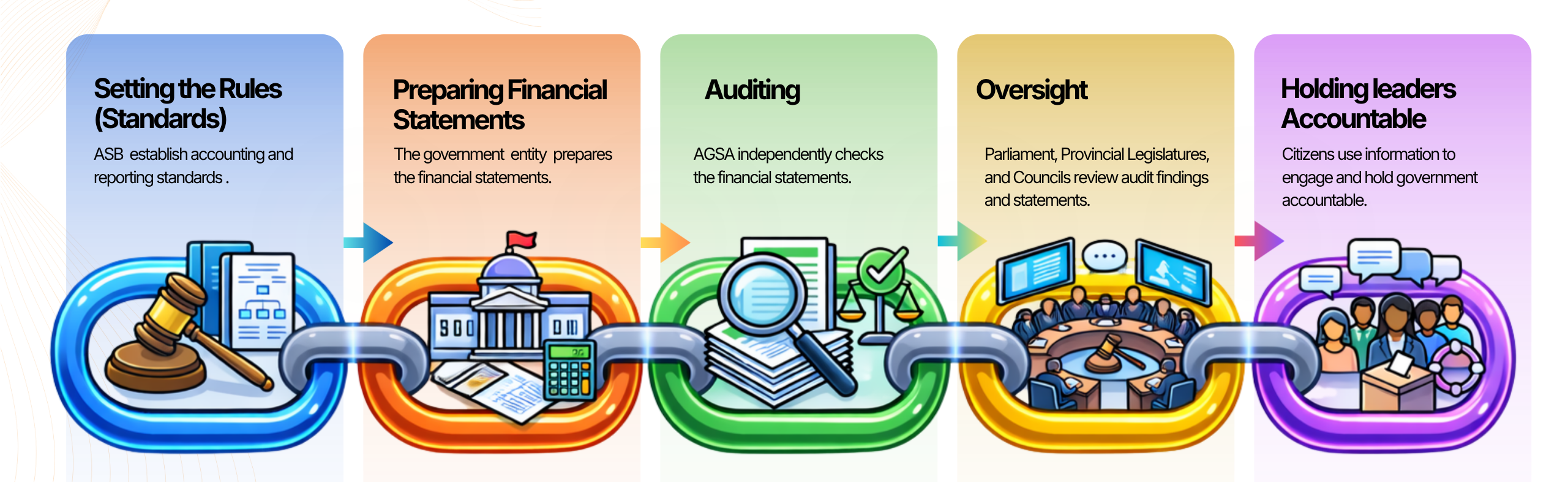
Every government entity prepares financial statements each year to show citizens how public money is used.

Entities applying GRAP*:

Entities applying MCS:

Note: For purposes of this Guide, the focus is on the entities that apply GRAP.

Who are financial statements for?

Financial statements are not just for accountants. They are for:

  • Legislatures and councils – To watch government spending.
  • National and Provincial Treasuries – To monitor and see the overall picture of public money.
  • Citizens, communities and their representatives – To see if money was used correctly and services delivered, and services can be delivered in future.
  • Funders, donors, and rating agencies – To check if the government is financially sound and accountable (responsible for their actions).

Who sets the rules, and who checks?

Different people make sure financial statements are made correctly:

  • Accounting Standards Board (ASB) – Sets the GRAP rules 
  • National Treasury (NT) – Issues the MCS rules for national and provincial departments. Provides budget rules.
  • Auditor General of South Africa (AGSA) – Checks the financial statements to see if they are trustworthy and follow the accounting rules (GRAP/MCS) and laws.

What is inside the financial statements, and how are they connected?

A complete set of financial statements usually includes:

  • Statement of Financial Position – Shows what the government owns (assets) and owes (liabilities) at year end.
  • Statement of Financial Performance – Shows money earned (revenue) and money spent (expenditure) during the year.
  • Statement of Changes in Net Assets – Shows how the government’s net worth changed during the year.
  • Cash Flow Statement – Shows how cash moved in and out of the government’s bank.
  • Statement of Comparison of Budget and Actual Amounts – Shows if actual spending matched what was planned (Note: Not all public entities have to make their approved budgets).
  • Notes to the Financial Statements, including Material Accounting Policies – The Notes to the Financial Statements explain the details behind the numbers. Material Accounting Policies explain how the government applies the rules from GRAP to items in the financial statements.
NOTE

The Government’s Rulebook and Extra Details

Material Accounting Policies and the Notes to the Financial Statement are important sections to read. Think of them like the user manual for the financial statements. They are the “rulebook” and “extra details” that explain how the numbers were prepared, and how to understand them properly.
Material Accounting Policies (usually at the start of the notes) explain the GRAP rules and methods the government used when preparing financial statements. They explain things like:
  • How money coming in (revenue) is recorded. For example, when services are provided, or when cash arrives?
  • How assets like roads, buildings, or vehicles are valued. This also includes how their value decreases over time through use.
  • How big guesses or estimates (judgements) are made. For example, how long something will last or how much money might be owed later?
The Notes to the Financial Statements provide extra details behind the big or important numbers in the financial statements. For example, they may:
  • Break large totals into detailed lists, like buildings, vehicles or loans.
  • Explain changes from last year.
  • Provide extra information to help understand what the numbers mean.
Reading the Accounting Policies and the Notes to the Financial Statements together helps citizens understand how the financial statements were put together and what the numbers mean.
These five statements are like chapters in the government’s financial story (activities). When you read them, they show where the government stood at the end of the year (position), what it did for the year (performance), how it changed at year end (changes in net assets), how it managed its cash during the year (cash flow), and if it kept its promises made before the start of the year (comparison of budget and actual).

Citizen Tip

These statements do not stand alone. They build on each other, and together they tell a complete financial story:

  • The Statement of Financial Performance links to the Statement of Changes in Net Assets which in turn updates the balances in the Statement of Financial Position.
  • The Cash Flow Statement shows how the year’s activities affected actual cash, as shown in the Statement of Financial Position.
  • The Comparison of Budget and Actual Amounts closes the loop by matching what was promised in the budget to what was actually spent.
Look at all statements, not just one, to understand the full picture. This Guide helps you ask the right questions. Knowing what questions to ask, helps you make sure that officials are held responsible for how they spend government money and deliver services.

PART B – Linking Financial Statements to Other Information

Understanding financial statements is the first step. But financial statements on their own do not tell the whole story. To see if the government is keeping its promises, you need to connect them with other reports, like budgets and plans. This section explains how everything fits together.

How the whole government "wallet" connects to the rules, plans and budgets?

🏠

Think of the Statement of Financial Position like a picture of a house. The assets are the rooms and furniture inside, and the liabilities are the loans used for building or furnishing it.

This house picture makes sense when you connect it to the plans, the spending, and the checks that went into building it.

Before the government builds something new, like a clinic or road, it needs a plan. There are two types of plans:

  • Long term plans (5-year view) - These are Strategic Plans (for public entities) and Integrated Development Plans (IDPs) (for municipalities) to set long-term goals. They focus on services and projects for the long-term. They also show how these will be paid for.
  • Annual plans (this year) - These are Annual Performance Plans (APPs) (for public entities) and Service Delivery and Budget Implementation Plans (SDBIPs) (for municipalities). They split the long-term goals into the yearly goals (projects and targets). They set budgets and include milestones to track progress. You can find these plans on the websites of individual entities and treasury portals.

The long-term plan explains what big projects will happen and why. The annual plan shows what will happen this year. It also shows how much it will cost and how it will be paid. For example, will the government use their own revenue, capital grants or a loan. It also shows how those projects link to the financial statements, like would it be adding to assets or be part of repairs and maintenance and what the impact will be on cash.

The Plan: The budget shows how much money the government plans to collect and spend for the year. It also show how the shortfall (if any) will be managed.

Capital budgets show asset projects, for example, new assets like new clinics and roads, or upgrading old ones, and how they will be paid for.

Operating budgets cover everyday revenue and daily costs. These could be like salaries, payments to suppliers, interest, repairs and electricity.

The Scorecard: The Annual Performance Report (APR) shows what actually happened compared to what was planned in the APP/SDBIP (shown in indicators and targets). This is called performance information. This explains the non-financial results of government. It includes the yearly indicators, targets, and the actual results. These could be, for example, how many houses were built, how many kilometres of roads were repaired, or how many households were connected to electricity. APRs are in the annual report with the financial statements.

The Check: After the government puts together its financial statements, an independent person called the AGSA checks this information. The AGSA issues a report that gives an opinion on whether the financial statements are trustworthy.

The Yearbook: The Annual Report is the government’s year-end story. It brings everything together in one book. It includes the following:

  • The APR - The goals set for the year and what was achieved.
  • Financial statements - What was earned and spent, the assets, liabilities, net assets at year-end, budget and actual comparisons, and cash flows.
  • Audit opinion - What the auditors found during their checks.
  • Governance and risk - Information on oversight, internal controls, and important risks.

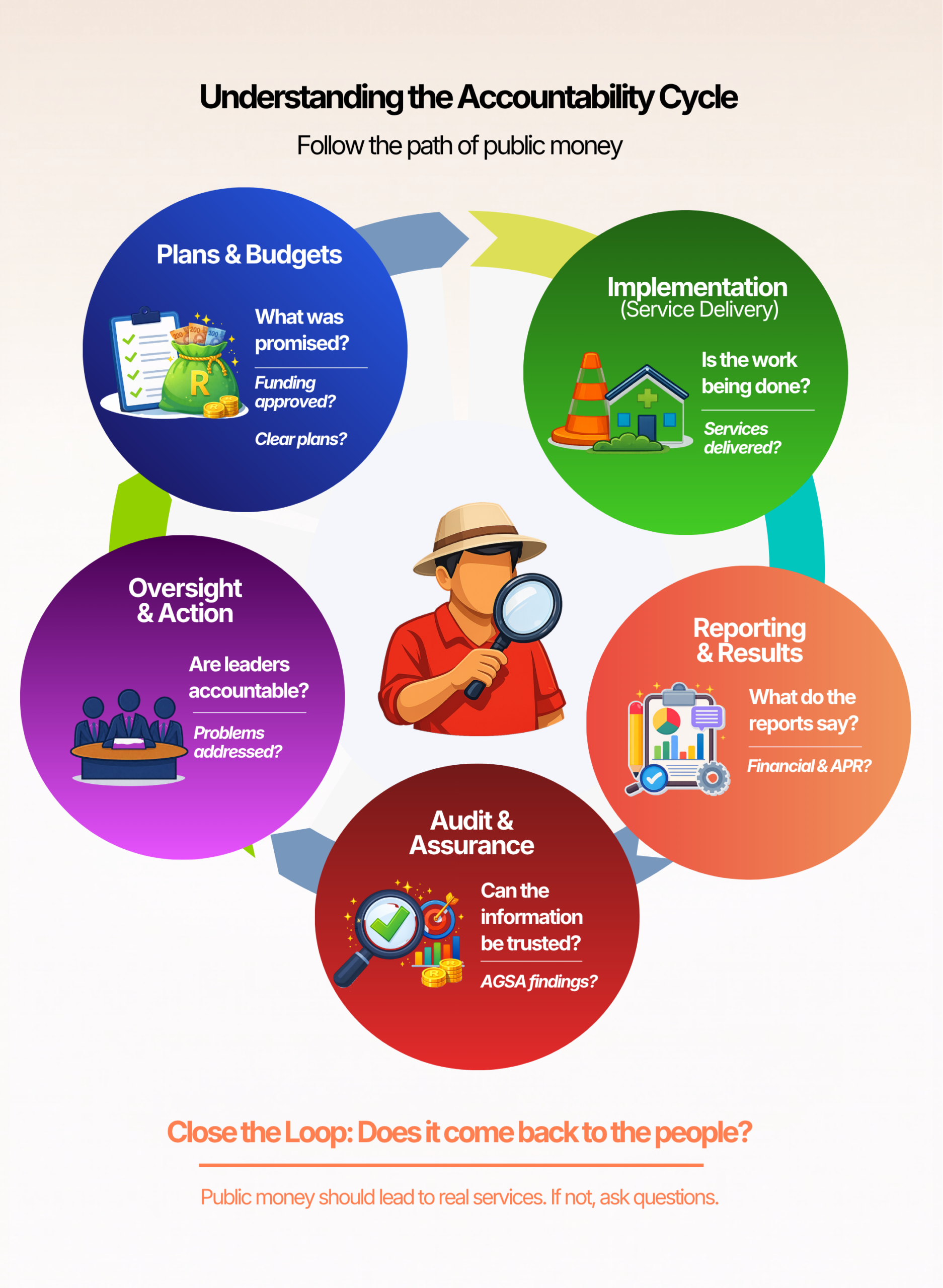
Understanding the accountability cycle

Accountability is not finished until the feedback reaches you. A healthy cycle means:
Transparency - Differences between what was promised and what was delivered are explained.
Improvement - You can see evidence that recurring problems are actually being resolved every year.
Action - Citizens use this information to ask questions in ward committee meetings or public hearings.
Do not just look at the money. Compare the financial report to the service delivery report. For example, if the money is 100% spent but only 20% of the houses were built, that is a red flag for your next community meeting.

PART C – Why Should a Citizen Care About These Reports?

Understanding government financial reports is about more than numbers. It is about whether the government is delivering on its promises to its citizens.

Financial statements are more than accounting rules. It is about understanding how government collects and spends money. It shows how that affects your community.
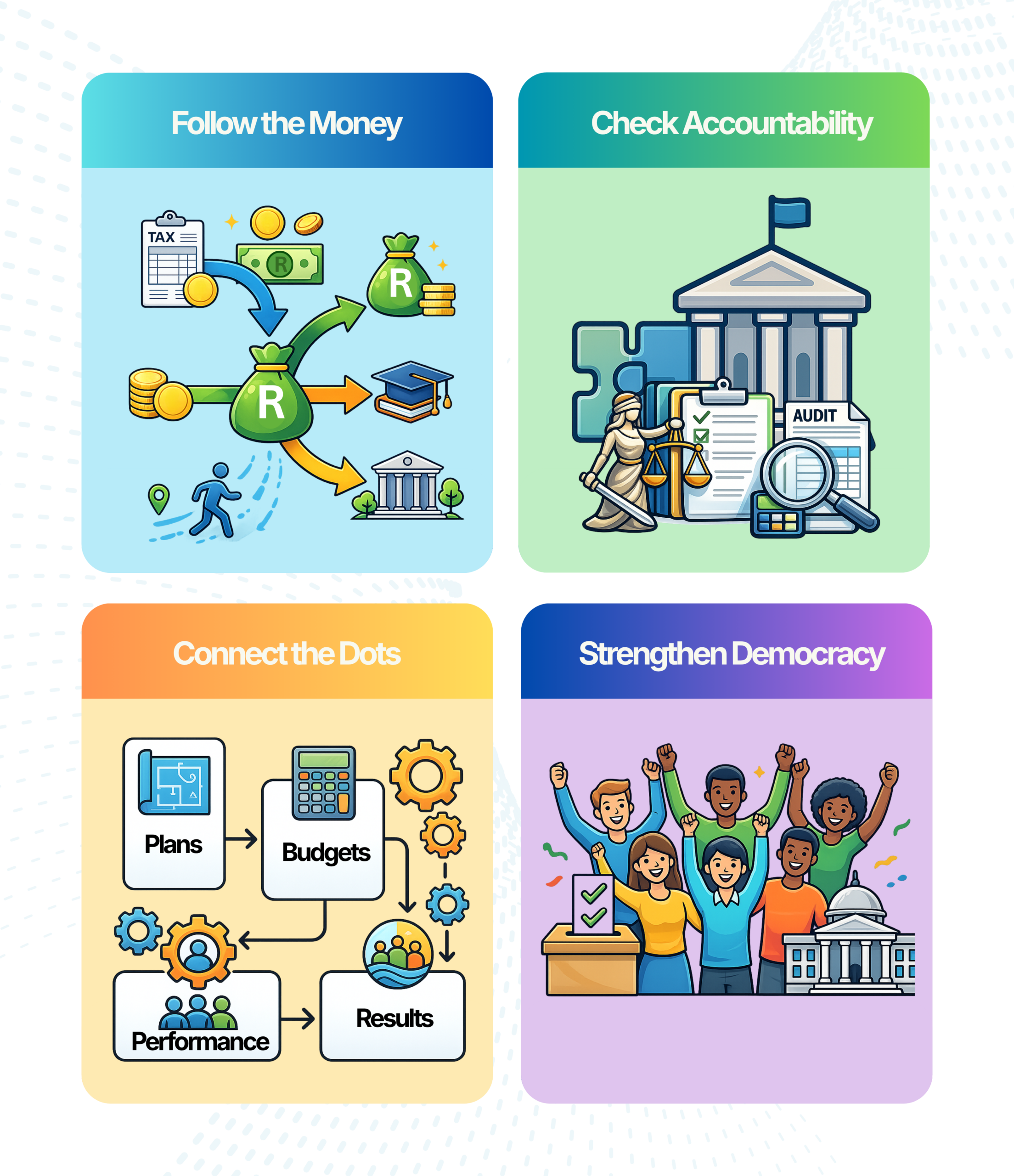
When you learn how to read financial statements, you can:
Follow the money – Check if taxes, rates, and grants were used as promised.
Check accountability – Identify waste, delays, or irregular spending.
Connect the dots – Link plans, budgets, and performance to actual results.
Strengthen democracy – Join in council/Parliament/Legislature meetings, budget talks, and oversight activities.

Checking the work

When you read these reports, you are checking whether the government officials are doing their job properly.

Ask yourself:

Is it fair?

Is money being shared fairly across the country or your community, or is your area being left behind?

Did the government officials keep their promises?

Did government spend its resources and were the services provided as promised?

Are these reports being honest?

Do the financial statements and performance reports tell the whole story, or are only the positive results being highlighted?

Checking the work

When you read these reports, you are checking whether the government officials are doing their job properly.

Ask yourself:

Is it fair?

Is money being shared fairly across the country or your community, or is your area being left behind?

Did the government officials keep their promises?

Did government spend its resources and were the services provided as promised?

Are these reports being honest?

Do the financial statements and performance reports tell the whole story, or are only the positive results being highlighted?

Spot the red flags

Clue 1: The Audit Outcome ("Report Card")

Where to look: 

Auditor-General’s Report

What to look for: 

The word “Unqualified” (this is a good outcome)

Red flag: 

Words like “Adverse” or “Disclaimer” may mean serious problems

Clue 2: Irregular or Wasteful Spending

Where to look: 

Notes to the Financial Statements (as required by law)

What to look for: 

“Irregular Expenditure” or “Fruitless and Wasteful Expenditure”

Red flag: 

Large or repeated amounts may indicate poor financial management

Understanding these reports helps you take part in how your community and country are run.

You can use this information when:

  • Attending community or IDP meetings
  • Speaking to your councillor
  • Participating in public discussions
  • Preparing to vote

Citizen Tip: Turn Information into Action

👉 Ask Yourself:

  • What concerns me most in these reports? Focus on issues that affect your community directly.

  • Can I explain this to someone else? If you understand it well enough to explain it, you are ready to act.

The Citizen's Checklist for Action

1

Take Your Findings to the Table

  • Attend Ward Committee or IDP meetings with your notes
  • Ask direct questions using facts from the reports
  • Write to your councillor or municipal officials and request responses
2

Share the Knowledge

  • Inform your neighbours and community
  • Use your vote to assess leadership and decisions

FINAL NOTE

These reports are only useful if they are used.

By understanding and using this information, you move from being an observer to an active participant in building a stronger, more accountable government.

Informed citizens strengthen democracy.